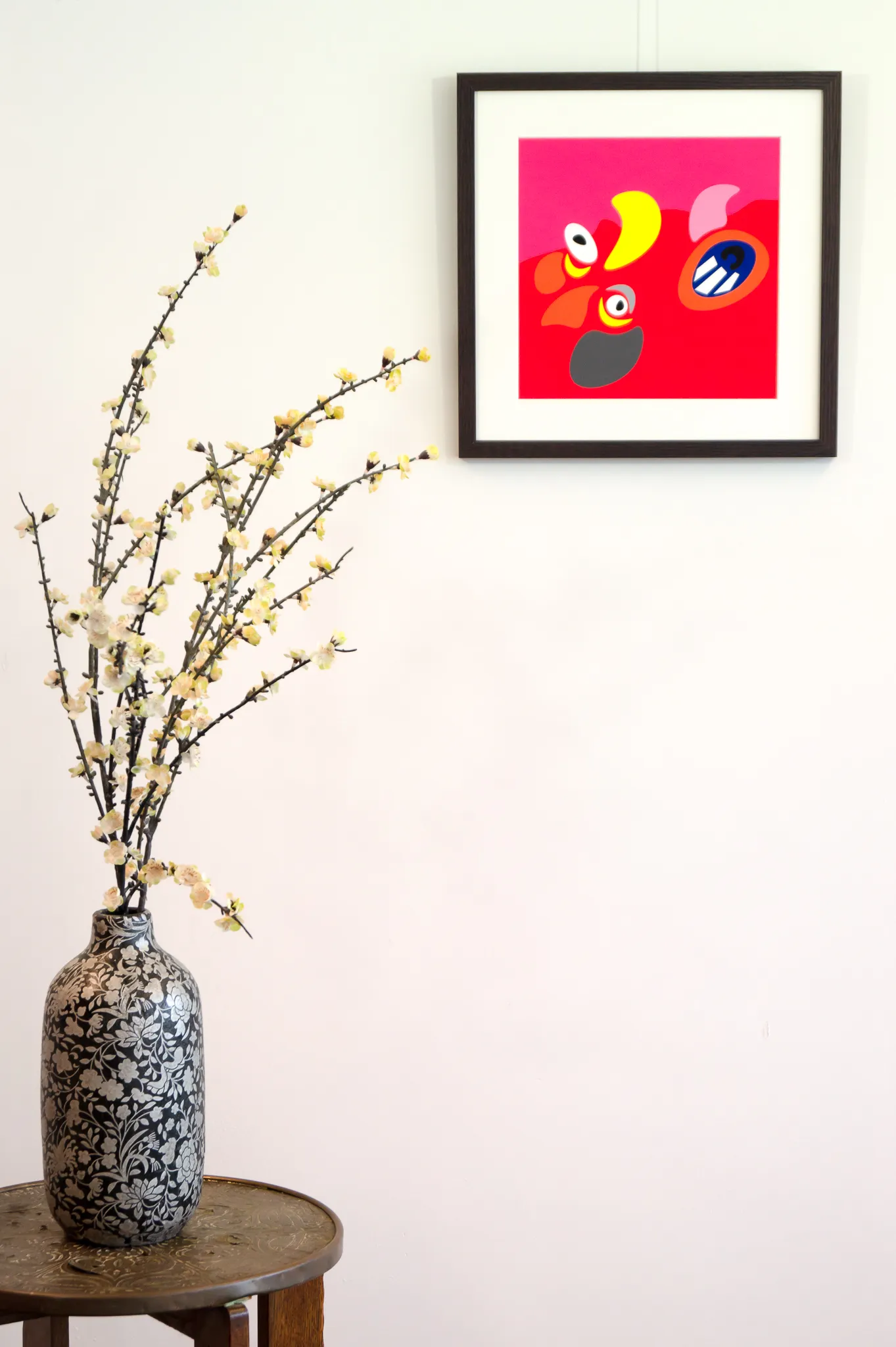
Een deel van het werk van Ingmar Spit is figuratief, vaak speels en stripachtig. Met vrolijke kleuren en een simpele vormentaal raakt hij relevante sociale en filosofische vraagstukken aan.
Portrait of a Daffodil I (Aquamarine) 30x30 cm sublimation print (2026)
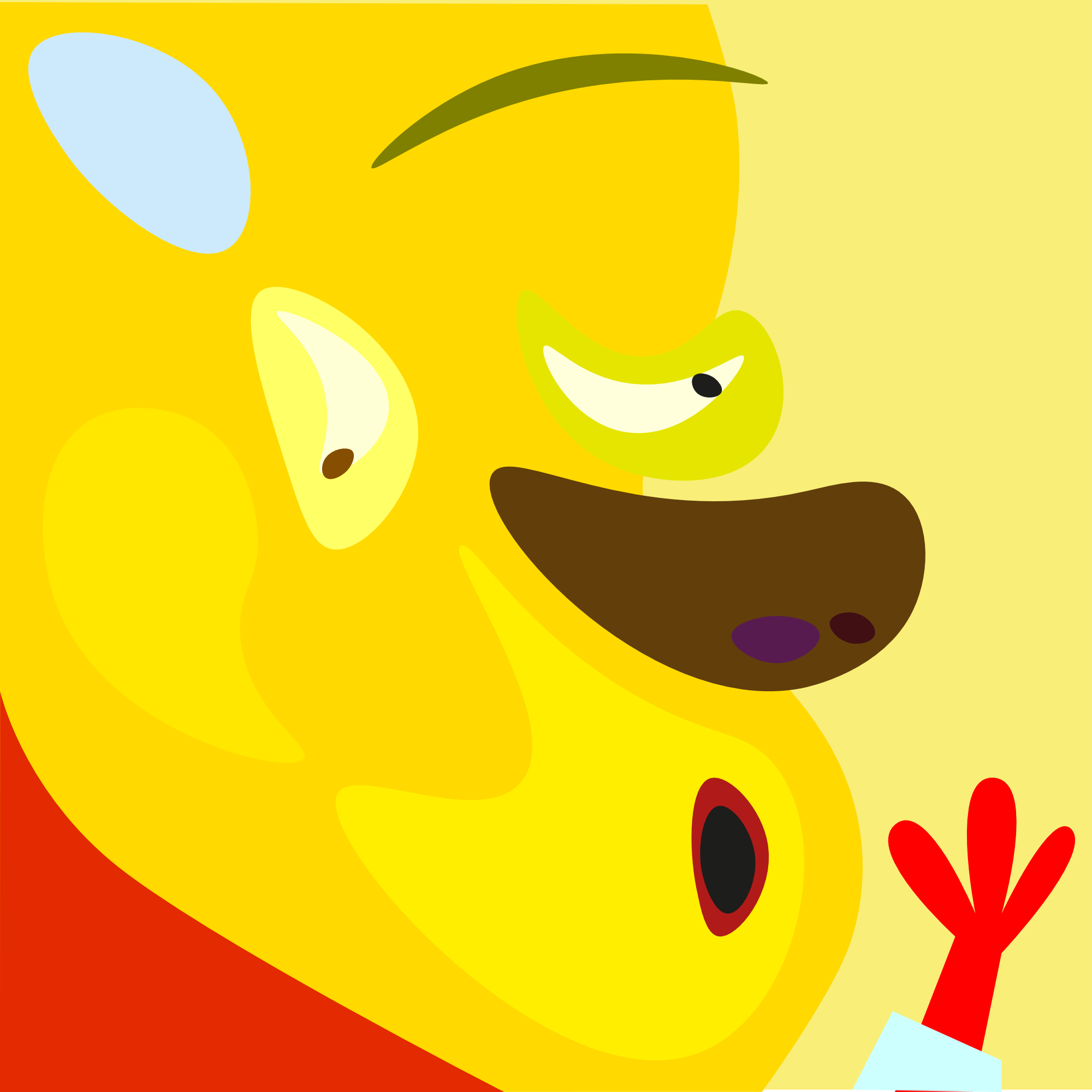
In ‘Portrait of a Daffodil’ we see the flower head of a yellow daffodil in profile. The heart of the daffodil is captured in fluid lines. The petals have a much more fragile appearance. Bruises and damage are visible. Light shines through the petals in some places, adding depth and life to the piece.
Portrait of a Daffodil II (2026)
These prints come in different varieties, just likeSpring Rain. By varying the colors, different printing techniques and materials each version takes on its own unique character. Sublimation prints on metal are available, as well as fine art prints on watercolor paper.
Portrait of a Daffodil I (Brown), sublimation print on aluminium 30x30 cm (2026)
Features and specifications
Title: Portrait of a Daffodil Year: 2026 Software: Affinity Designer Process: Sublimation printing Material: Aluminium Dimensions: 60×60 cm and 30×30 cm
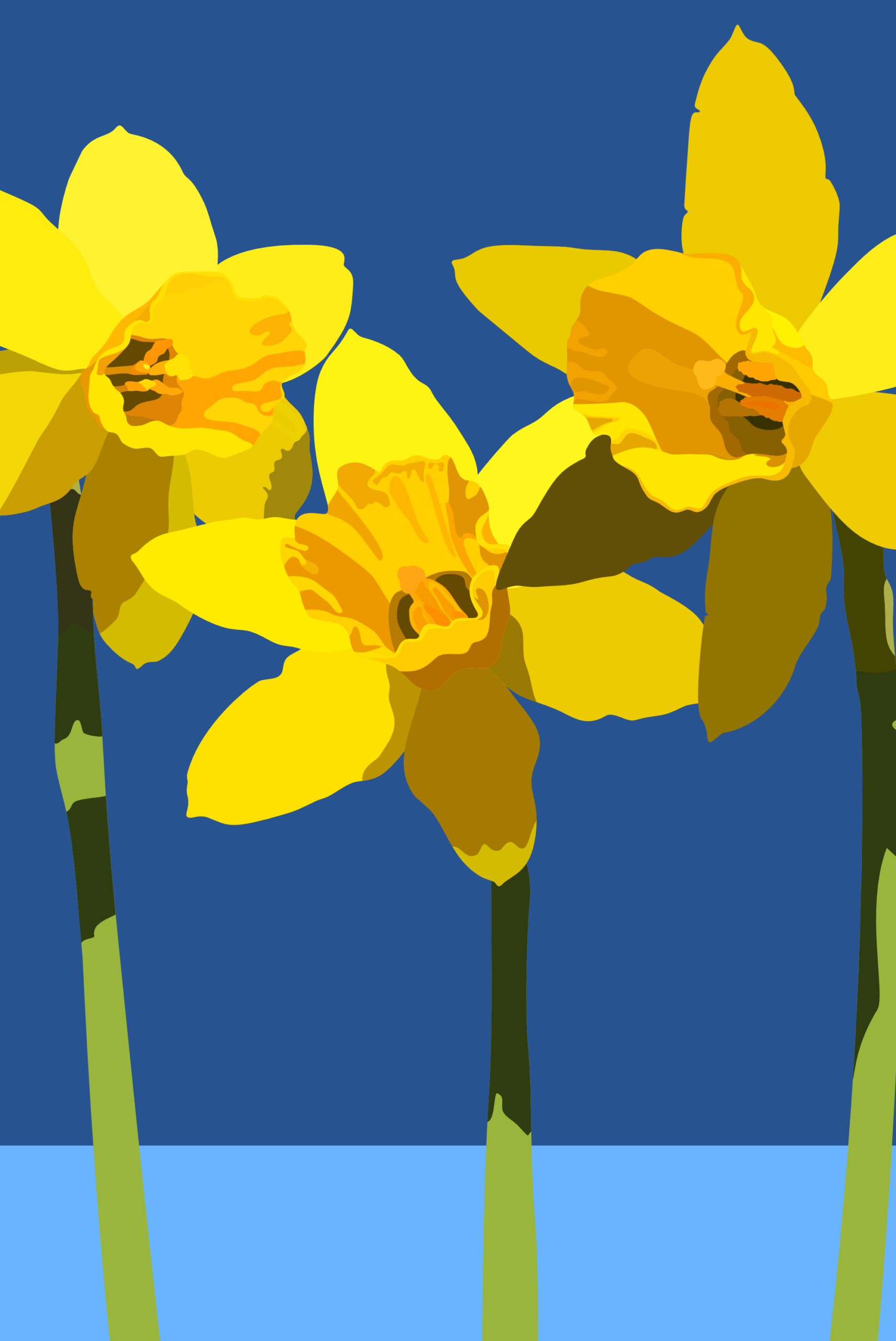
Rise of the Daffodils - Sublimation print on aluminium (matte) 40×60 cm (2026)
In 'Rise of the Daffodils', three yellow flowers pose triumphantly, as if it were a portrait of a guild. The work is straightforward and direct, but still captures a sense of the subject's gentle nature.
The daffodils stand out from their stylized background, which is little more than a horizon line. The petals are rendered as flat surfaces with patches of shadow. They get a sense of depth and direction through the use of different shades of yellow.
Daffodils are true flowers of spring, but in this setting they appear defiant and militant. The artist explains: “I started drawing an army of flowers, out of a sense of self-preservation, really. I find the hardening of public life to be an incredible ugliness. Here in Almere, thousands of daffodils bloom every spring, as if an enormous army of flowers rises up against the ugliness of intolerance and exclusion.”
Rise of the Daffodils - Sublimation print on aluminium 60×40 cm (2026)
Ingmar is currently working on a small series of daffodils. The second work in this series isPortrait of a Daffodil.
Features and specifications
Title: Rise of the Daffodils Year: 2026 Software: Affinity Designer Process: Sublimation printing Material: Aluminium Dimensions: 60×40 cm
The flowers in ‘Spring Rain’ gently float against a backdrop of a rising sun. The colors have been shifted, which makes the image feel a bit abstract and slightly psychedelic. Still, it has a calming aura: the flowers fall like a gentle blanket.
These prints are inspired by Japanese printmaking. In the Japan Museum Sieboldhuis at the city of Leiden, Ingmar visited exhibitions of this traditional woodblock print art, which made a great impression on him.
The prints are a reaction to changes in our culture, where Ingmar is looking for ways to resist the growing intolerance that he sees. This has led to a series dedicated to flowers, including ‘Rise of the Daffodils'and 'Portrait of a Daffodil‘.
Spring Rain I (orange on blue) – 80×80 cm (2026)
The prints are available in different versions. Two of these have been produced so far: ‘blue on orange’ and ‘orange on blue’. In addition to the inkjet prints on acrylic that have already been published, the series also includes editions on fine art paper and as sublimation prints on metal.
Features and specifications
Title: Spring Rain Year: 2026 Software: Affinity Designer Process: Sublimation or inkjet printing Material: Acrylic, watercolor paper, or aluminum Dimensions: 80×80 cm
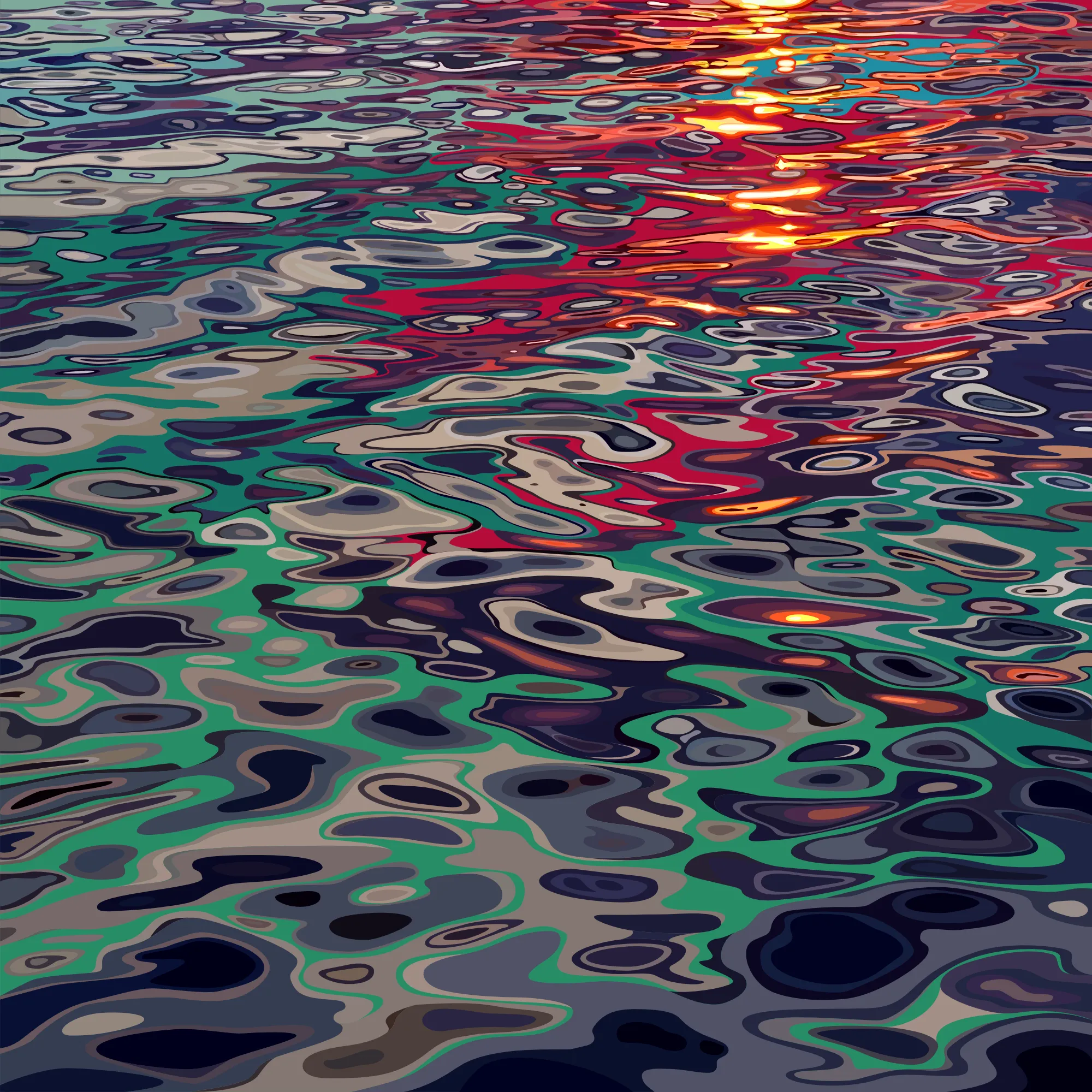
'Liquid Modernity' is a visual contemplation on the fluidity of our modern society. In the piece, we see a rolling water surface reflecting sunlight. The color palette is unusual and clashing: green, aquamarine, red, and even a small splash of light blue compete for a seat on the dark blue waves.
The title of the work is taken from Zygmunt Bauman’s book ‘Liquid modernity’: modern society is portrayed as temporary, flexible and constantly changing, in contrast to the fixed structures of the past. As a result, cruelty in our societies has become more intangible. Bauman refers to this as the ‘liquidity of evil’.
This print is part of a series of works such as 'Weight, monument for comma seperated values', in which the artist reflects on a life shaped by hypertechnological developments.
Two young faces, butterfly wings, the outline of an egg with a keyhole in its centre – all brought together in a single image. It refers to the butterfly effect from chaos theory: the concept that small changes at the outset of a complex system can have unpredictable consequences over time.
This art print was created for photographer and council member Suzanne van der Laar, following conversations during an exhibition of Ingmar’s work in the faction roomSuzanne is a remarkable individual: with boundless energy and a natural ease, she draws attention to her passion for culture, diversity, solidarity and inclusivity. When she asked him to create something for a political campaign, Ingmar created something for her personally instead.
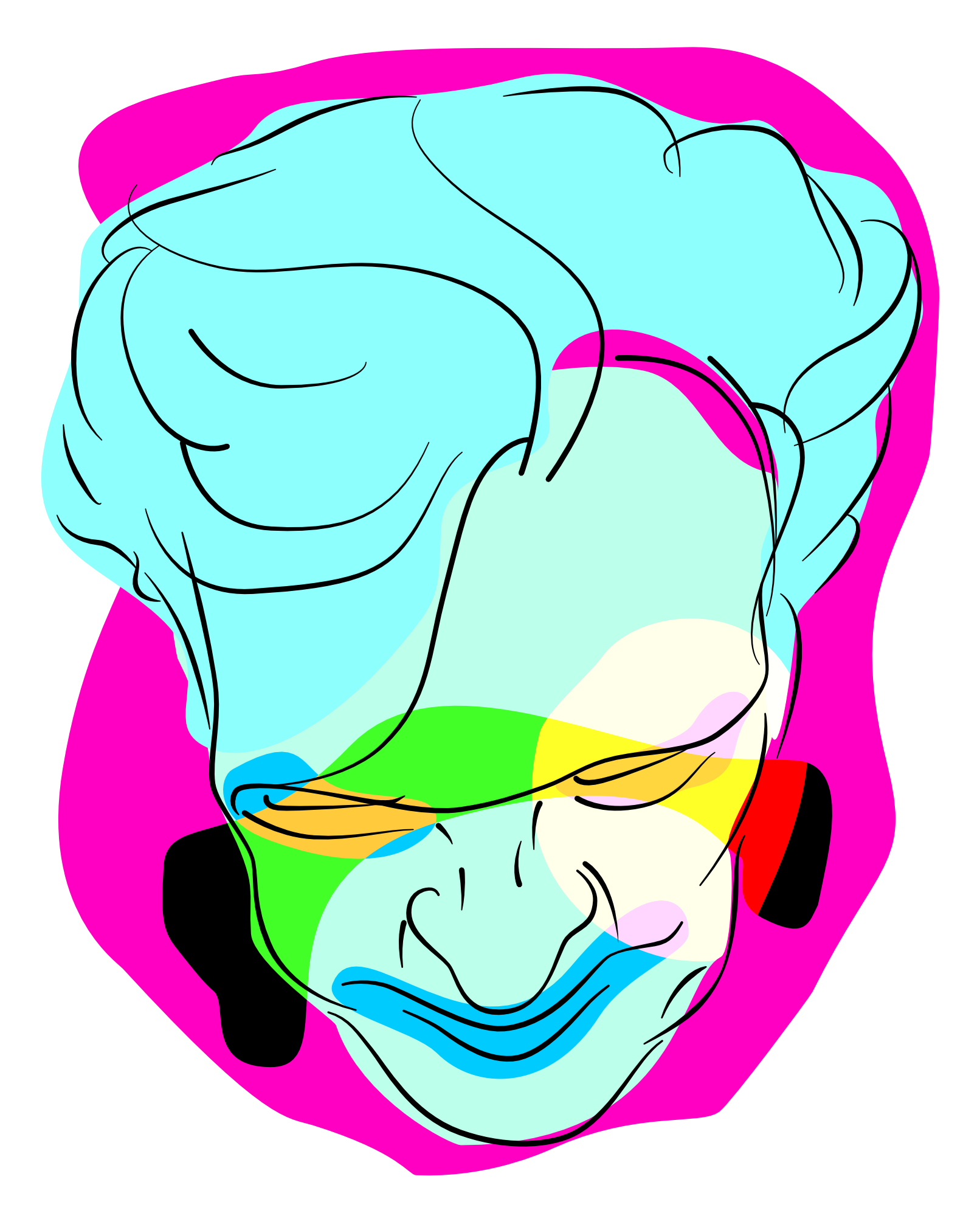
‘Self-Portrait’ (2025) reveals Ingmar’s love for Matisse’s. Pen on paper, digitised by hand (below), then coloured in Affinity Designer. The final result is a fine art print on watercolor paper.
Digitised line drawing (2026)
Features and specifications
Title: Self Portrait Year: 2025 Software: Affinity Designer Process: Fine art print Material: Watercolor paper Dimensions: 40x30 cm
Tätigkeit der Hypofyse, inkjet on acrylic panel, 90×90 cm (2019)
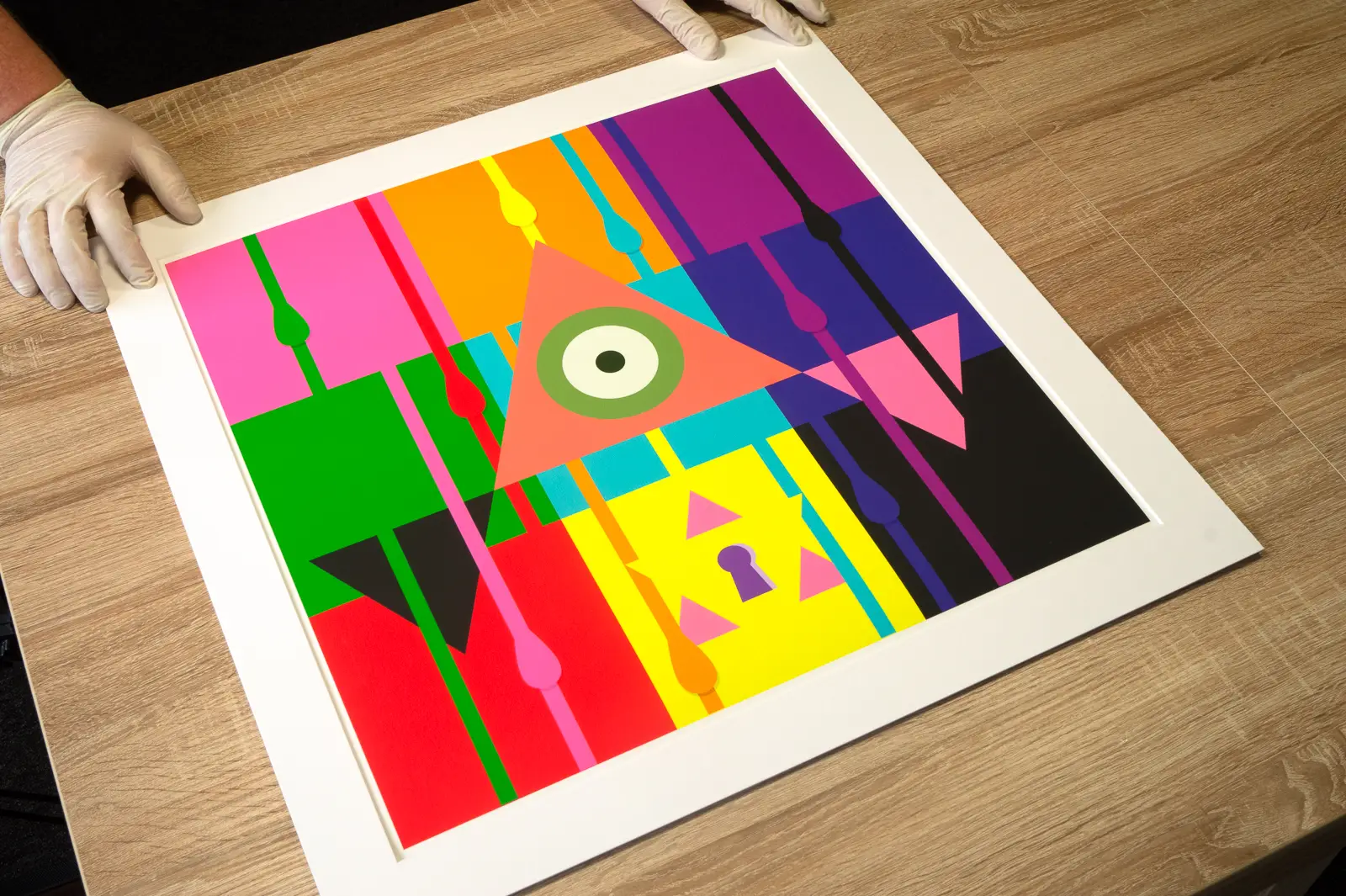
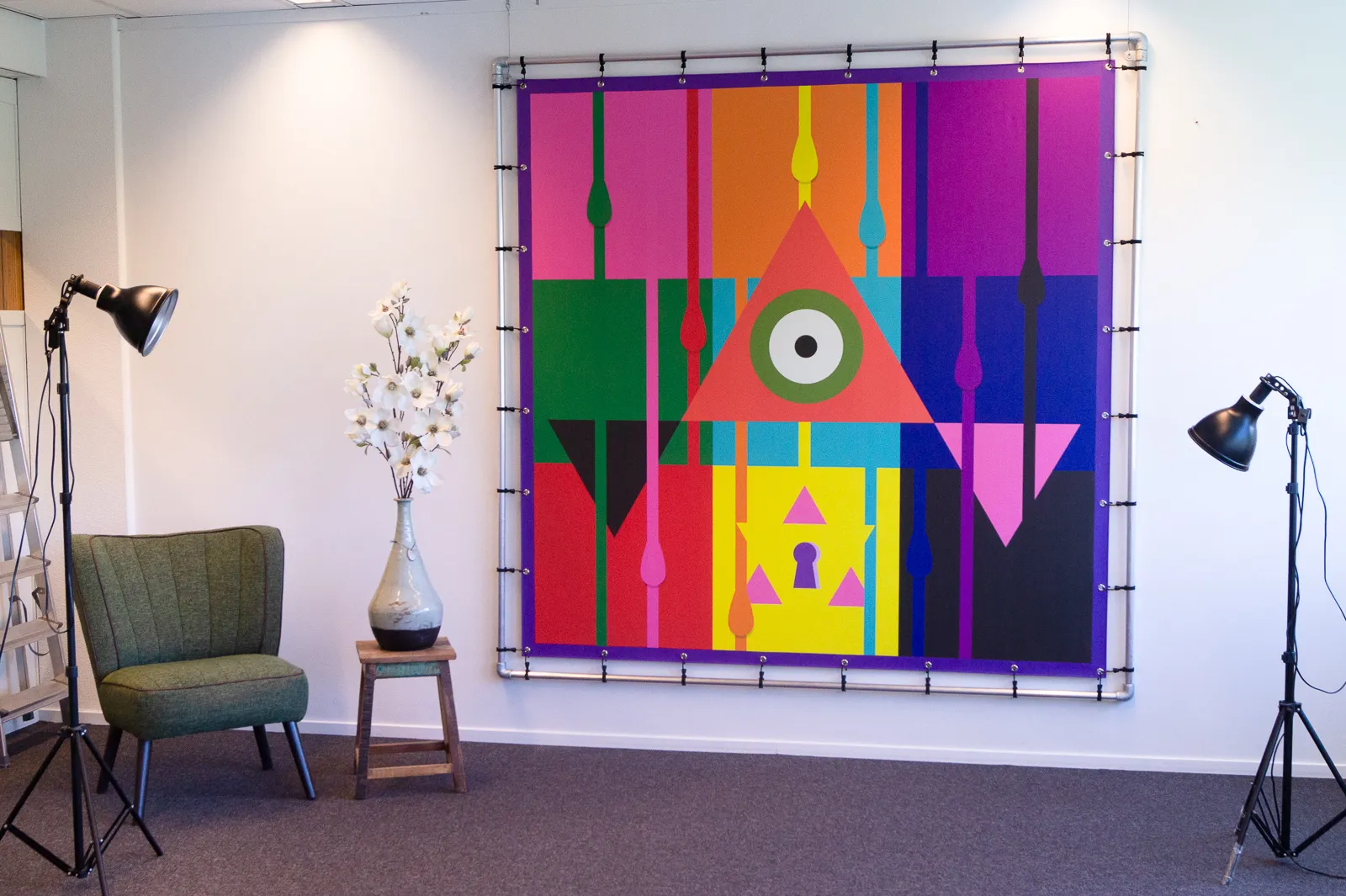
Composed of squares, triangles, circles and lines, this work borders on abstract art. When we look at the triangles, squares and circles, we see symbols that are darker than the cheerful colours might suggest.
The colourful squares refer to the LGBTQ movement's rainbow colours, where they represent visibility, diversity and pride In the middle sits the Eye of Providence: originally a symbol of an all-seeing and caring love. Right below it, smack in the middle of a pink-yellow davidstar, a keyhole. The triangles have the same colours and shape as those found in Second World War extermination camps. The droplets create streaks across the image, as if the squares bleed their own colour.
Tätigkeit der Hypofyse – fine art print on watercolor paper, 50×50 cm (2019)
This geometric artwork from 2019 highlights the resurgence of intolerance towards anyone who is labeled as different or deviant. Following the successful emancipation efforts of previous years, this is a deeply troubling development.
Tätigkeit der Hypofyse – inkjet print on vinyl, 200×200 cm (2019)
This digital artwork is being printed in a variety of techniques and materials. In 2019, a first edition measuring 200 × 200 cm came out, printed on vinyl. In 2021, the piece, together with a series of designs from that period, was released as 50 × 50 cm fine-art prints. The most recent edition (2025) is an inkjet print on a 90 × 90 cm acrylic panel.
Features and specifications
Title: Tätigkeit der Hypofyse Year: 2019 Software: Illustrator Process: Inkjet printing Material: Acrylic plate Dimensions: 90×90 cm
Fine Art Print on watercolour paper, 150 x 80 cm (2020)
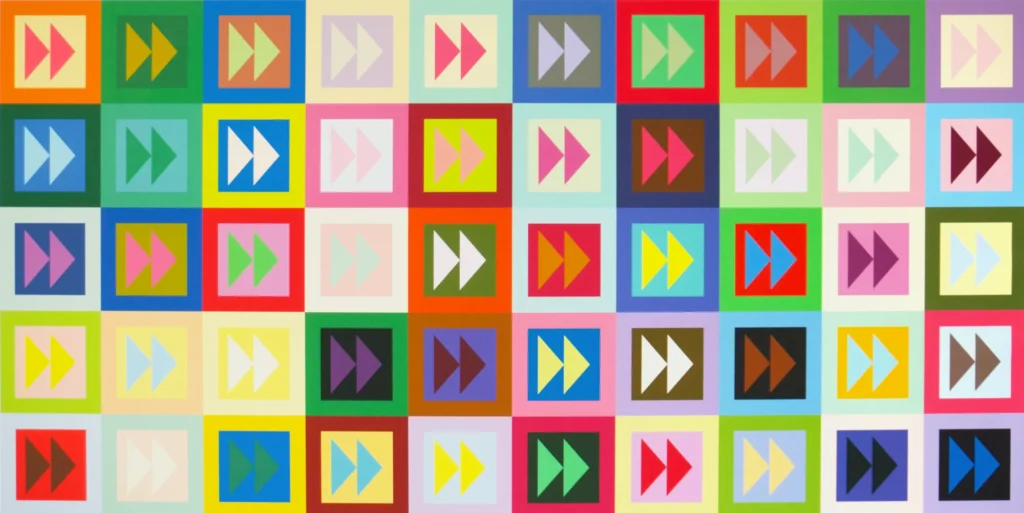
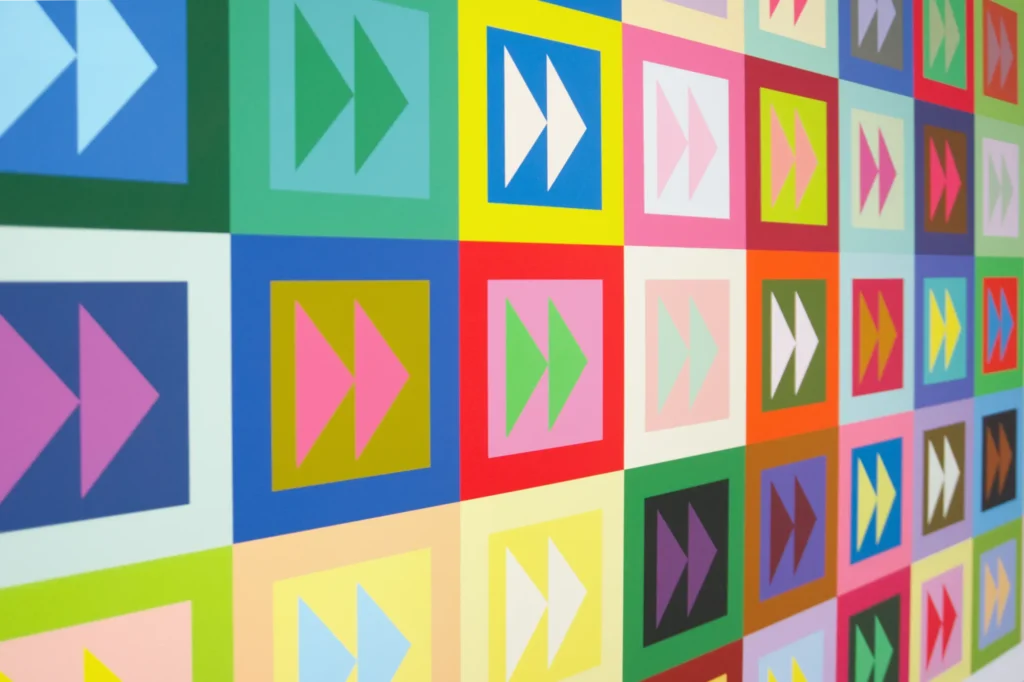
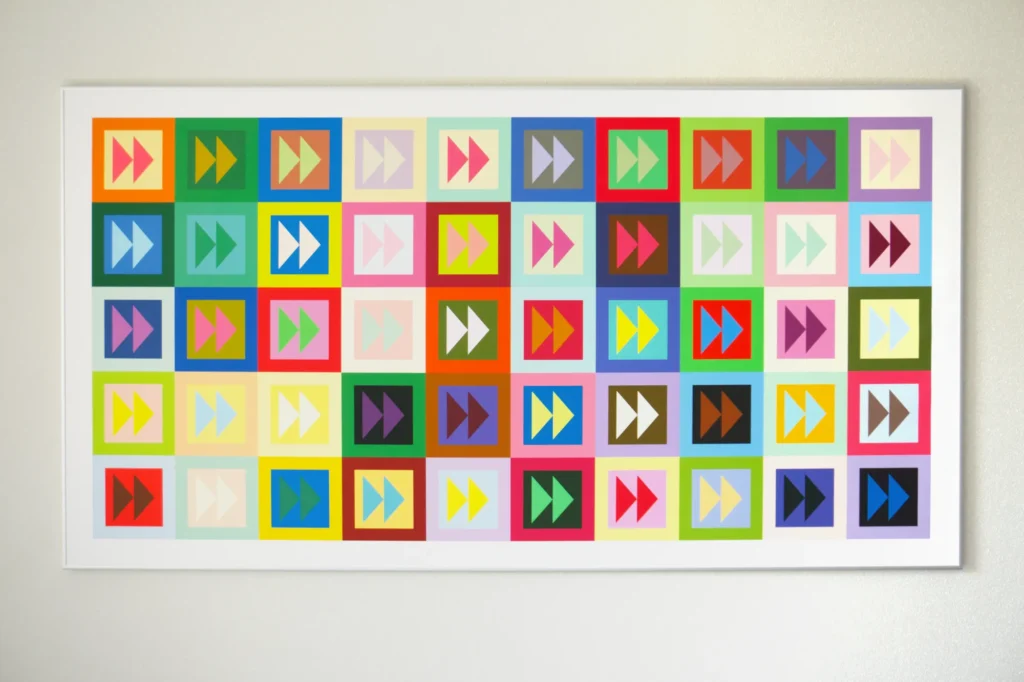
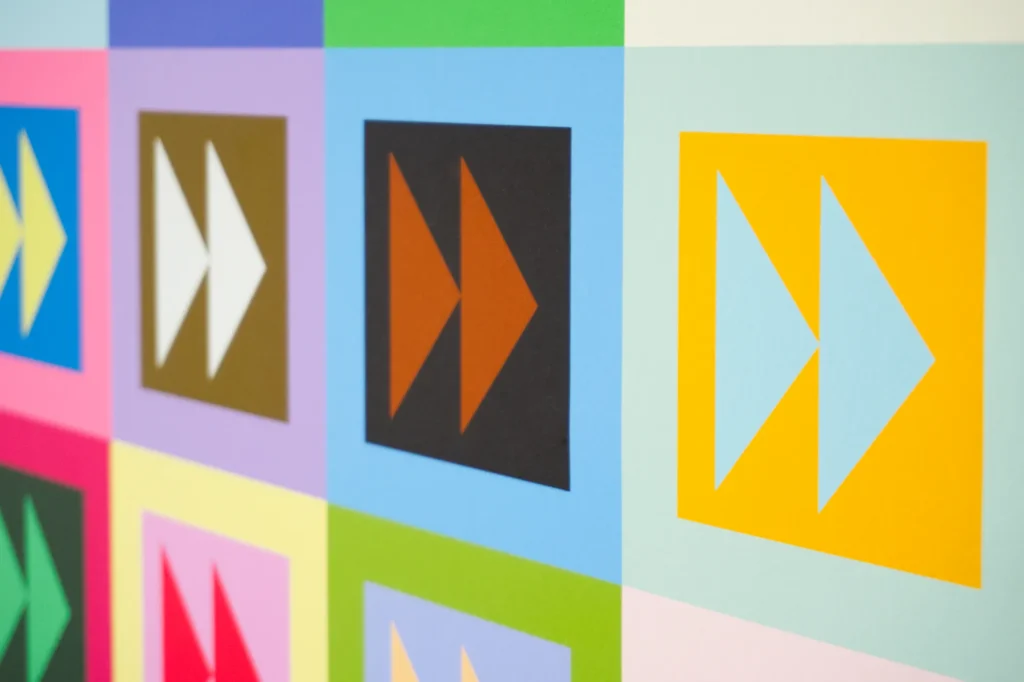
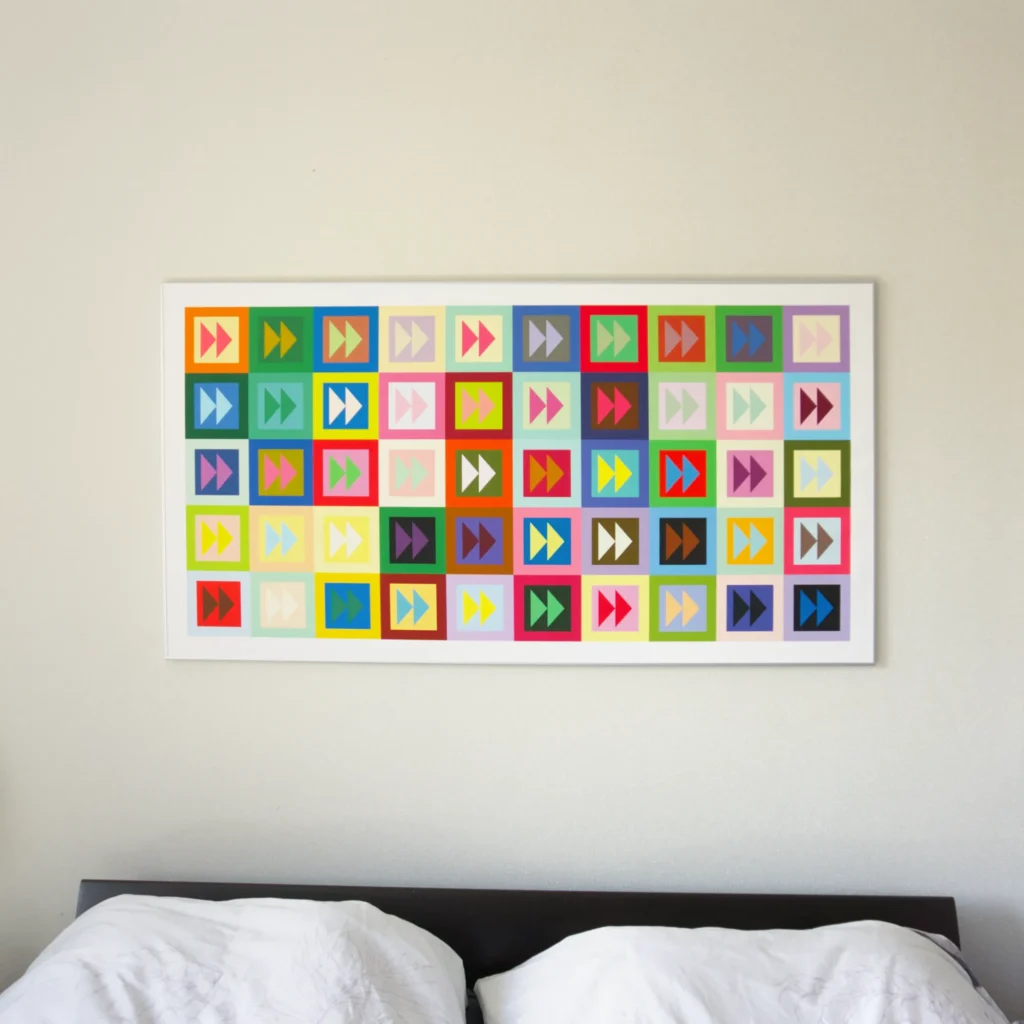
‘Fast Forward’ consists of fifty cheerfully coloured blocks, each featuring a fast-forward button like we are all familiar with from video apps, cassette players and other media players. The repetition of the double arrows creates a strong visual sense of acceleration.
“The idea for this print came about during a conversation at the breakfast table, in the early days of the coronavirus pandemic, immediately after the lockdowns were announced. We were discussing how great it would be to fast-forward through life for a moment, so that nobody would have to go through what lay ahead.”
Fine art print on watercolor paper (artist's collection) – 150×80 cm
Each button consists of three colours: arrows, background and border. Each of the 150 individual colours is unique: a reference to individuality within a society. Ingmar uses this motif of unique colours elsewhere, like in ‘MEME‘.
Fast Forward art print, digital version (2020)
Features and specifications
Title: Fast Forward Year: 2020 Software: Illustrator Process: Fine art print Material: Watercolor paper Dimensions: 150×80 cm
Matter – Fine art print on watercolour paper, 50×50 cm (2020)
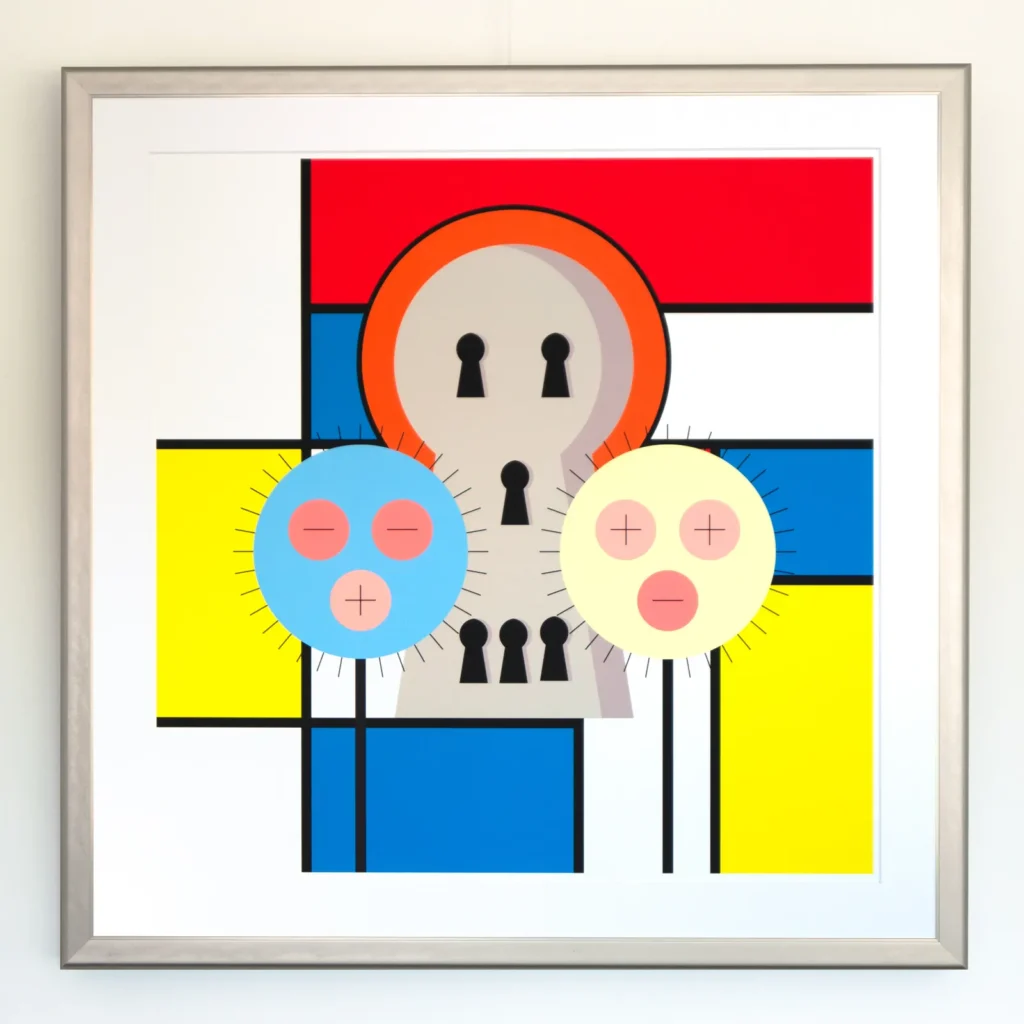
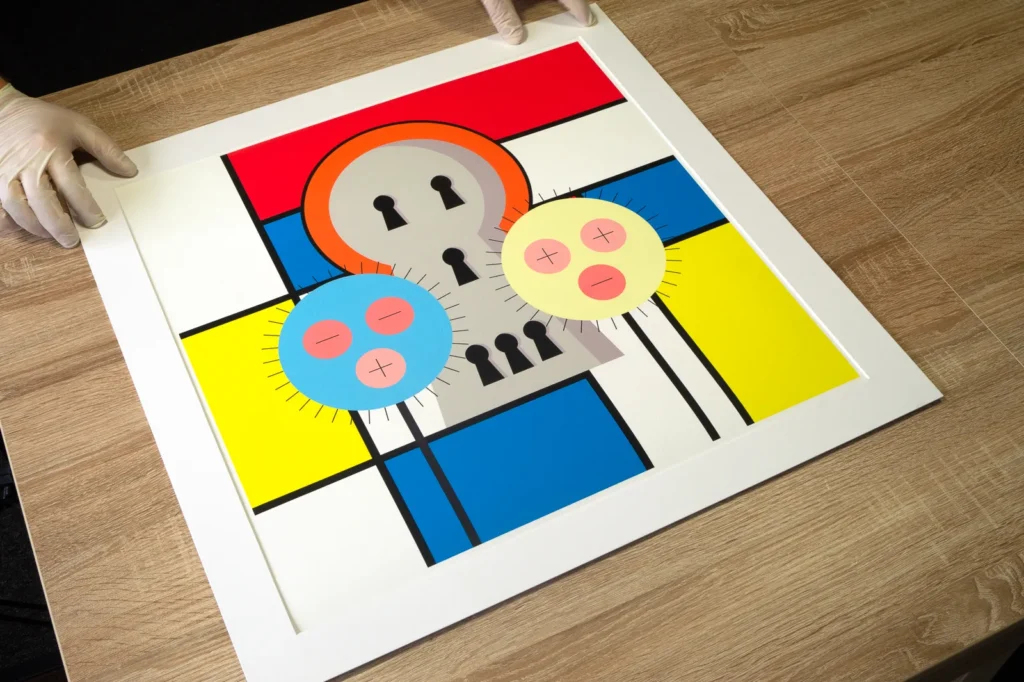
In ‘Matter’, the intuitive yet meticulous approach Ingmar takes to his art is perfectly reflected. The central figure, assembled from the shapes of keyholes, depicts a skull, a saint and a keyhole. Thanks to some cleverly placed cast shadows, this guardian of secrets appears to have been cut out of a self-composed Mondrian.
The two small figures at the front are schematic representations of subatomic particles: a proton and an electron. The eyes and mouth form a schematic representation of charge or spin: positive and negative, attraction and repulsion. At the same time, the lines and crosses are a means of depicting expressions in comic strips: these are the faces of stick figures.
In this way, Ingmar's symbolism is both explicit and intuitive.
Matter – Fine art print on watercolour paper, 50×50 cm (2020)
The work has been rendered as a fine art print on watercolour paper and is hanon display in the laboratory of a theoretical quantum physicist.
Features and specifications
Title: Matter Year: 2020 Software: Illustrator Process: Fine art print Material: Watercolor paper Dimensions: 50×50 cm
So long and thanks for all the fish – art print on acrylic panel, 80×80 cm (2019)
‘So long and thanks for all the fish’ is an unsettling iconographic image that is, at the same time, light-hearted due to the colours, style and tone of voice. The composition is playful and graphic, with precise lines and intuitively chosen blocks of colour that are characteristic of Ingmar’s figurative, abstract and typographic work.
At the centre is a terrified figure of Christ, revealing his hands dripping with green blood. His unusual nudity, sharp teeth, single eye and keyhole are equally striking. Behind Christ, we see a medallion and three fish, a symbol of Christ himself, but also a reference to Douglas Adams’s science fiction series 'The Hitchhiker’s Guide to the Galaxy'.. In it, dolphins depart from Earth – which has been condemned to the scrap heap – with the message ‘So long and thanks for all the fish’.
‘Icons‘ is a series of pop art prints created by Ingmar in 2019 and 2020. In this series, modern and historical narratives are submerged in colour and intuitively woven together. Bright, contrasting colours and clean, graphic outlines strip the imagery of its religious earnestness and place it in the world of pop art.
So long and thanks for all the fish – Fine art print on watercolour paper, 50×50 cm (2019)
‘So long and thanks for all the fish’ has been published as, amongst other editions, a fine art print on 50×50 cm watercolour paper. In addition, a large 150×150 cm inkjet print has been produced on vinyl, and the icon is available as an inkjet print on an 80×80 cm acrylic panel.
Features and specifications
Title: So long and thanks for all the fish Year: 2019 Software: Illustrator Process: Inkjet printing Material: Acrylic plate Dimensions: 80×80 cm
Bad penis - Fine Art Print on watercolour paper 50 x 50 cm (2020)
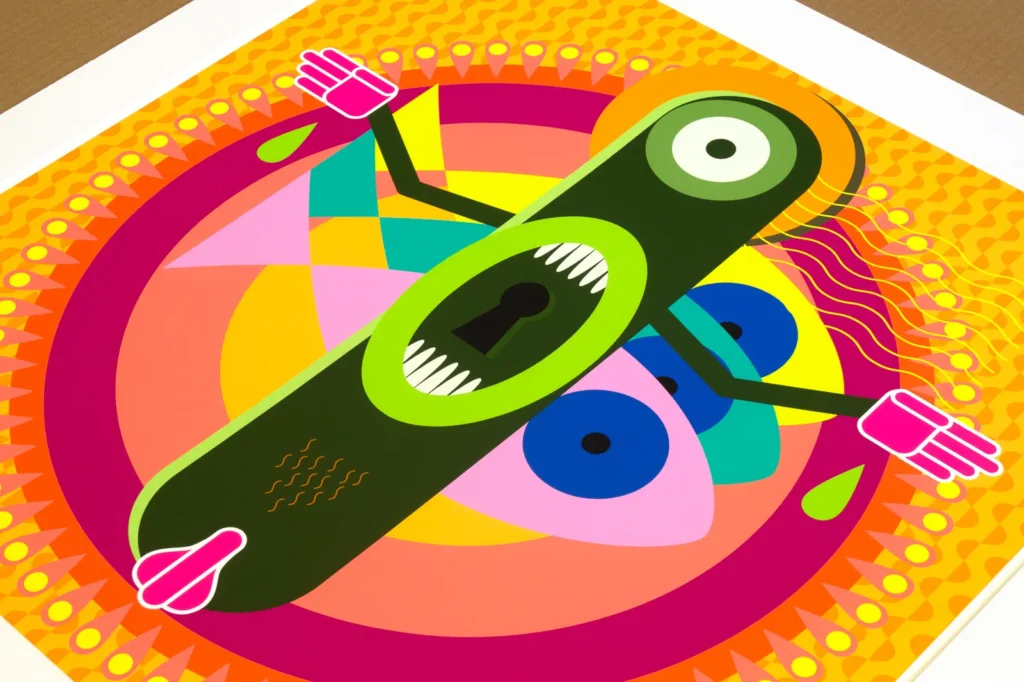
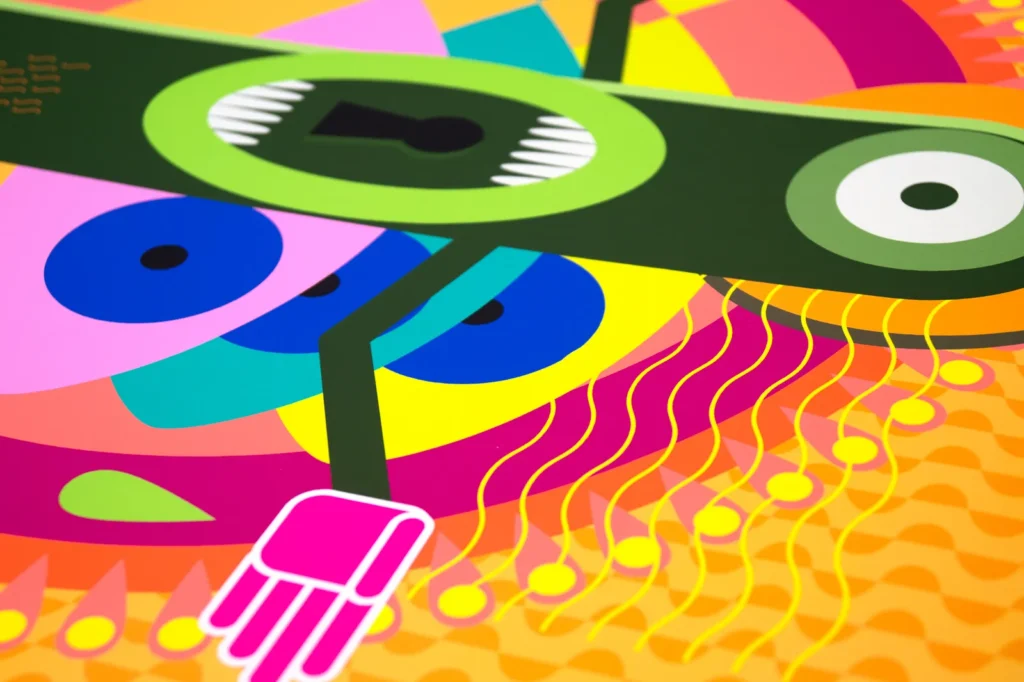
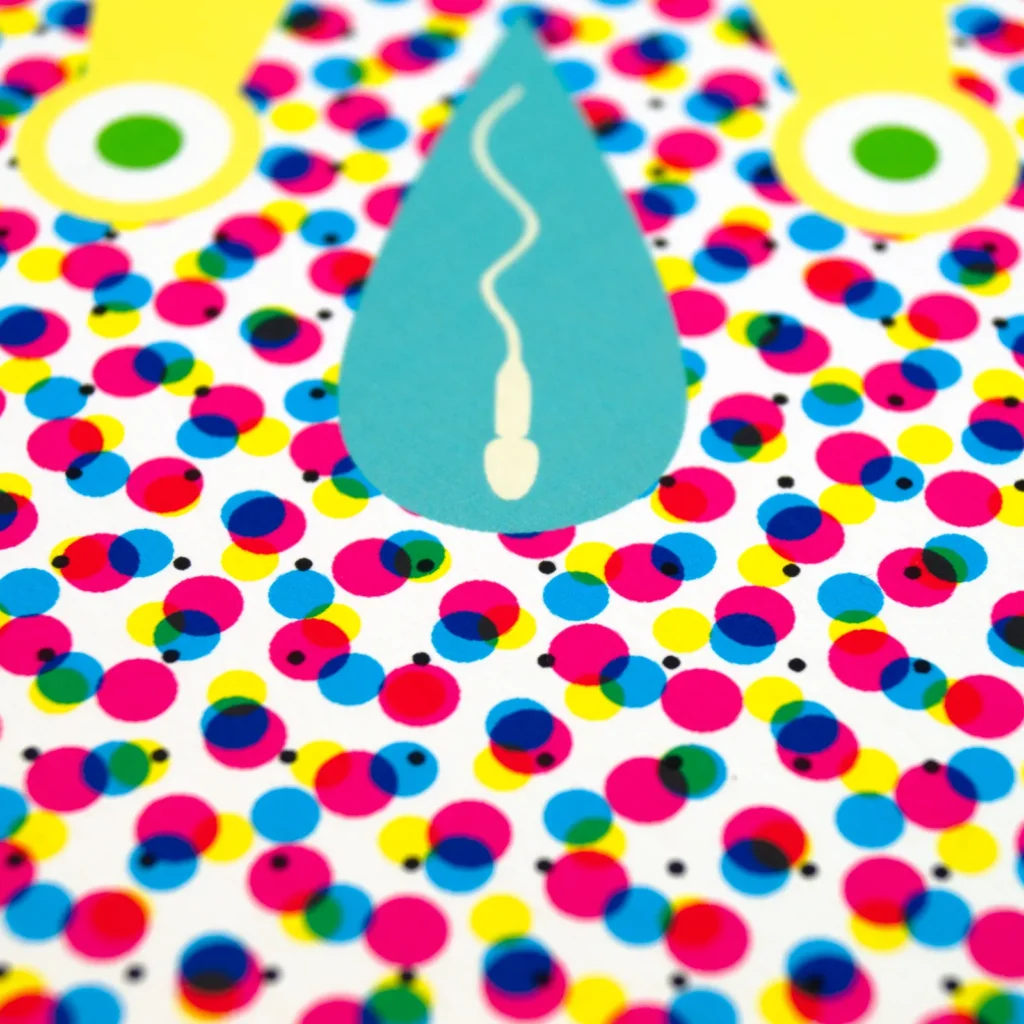
‘Bad Penis’ is an ironic caricature with a psychedelic vibe. In the middle of the piece, a penis with edgy little wings and a grumpy face stands on a stool. Behind the bad-tempered penis, there's a pink ring with dots and a dark hole surrounded by a wreath of sperm cells, along with small keyholes each containing a tiny eye. The background features a bustling half-tone pattern commonly used in newspaper and magazine printing.
The print uses stark colour contrasts: blue, pink, yellow and turquoise. This makes the work cheerful, provocative and absurd. The halo and the buffoon character hoisted onto a stool lend the image a ceremonial air, as if it were a well-known cultural icon. The silhouette also bears a resemblance to a totem pole out of an old comic strip.
The print was created around the height of the ‘MeToo’ initiative: a cultural wave of emancipation and participation that continues to raise awareness and expose abuse to this day. The visual elements are designed to evoke specific associations. The stool, the grumpy expression, the figure’s laughable appearance, the droplets of sperm flying everywhere, the absurd silhouette of a crucified martyr, the absence of testicles and the psychotic halftone pattern are all references to the scandals and their exposure.
Bad penis - Fine Art Print on watercolour paper 50 x 50 cm (2020)
The print is part of the 'Iconsseries, which reflects on western cultural developments.
Features and specifications
Title: Bad penis Year: 2020 Software: Illustrator Process: Fine art print Material: Watercolor paper Dimensions: 50×50 cm
Die Welt weint – Fine art print on watercolour paper, 50×50 cm (2019)
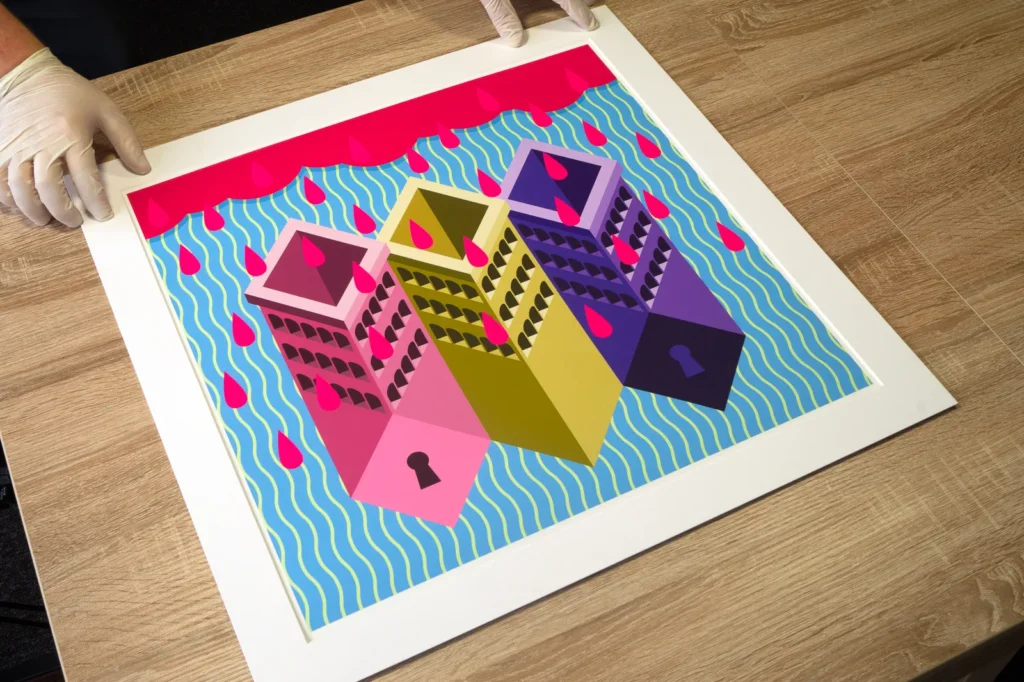
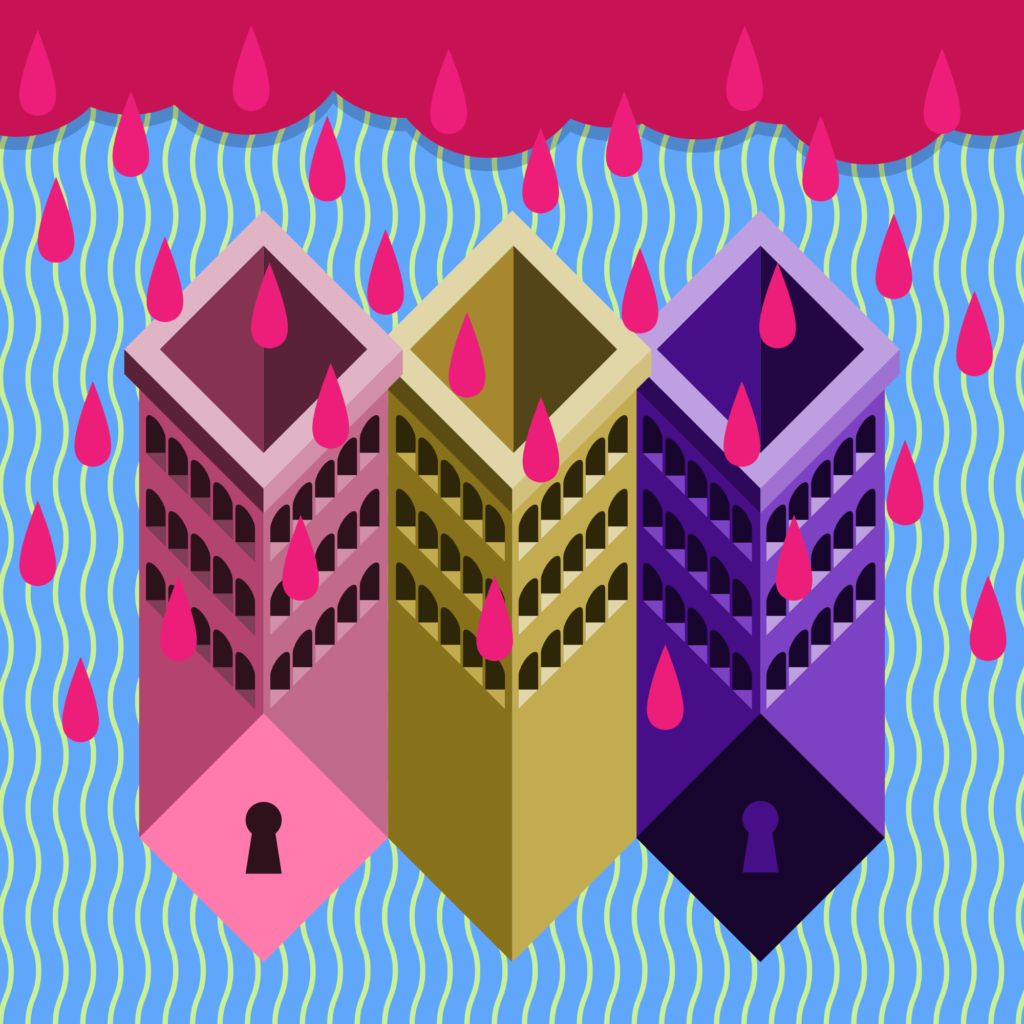
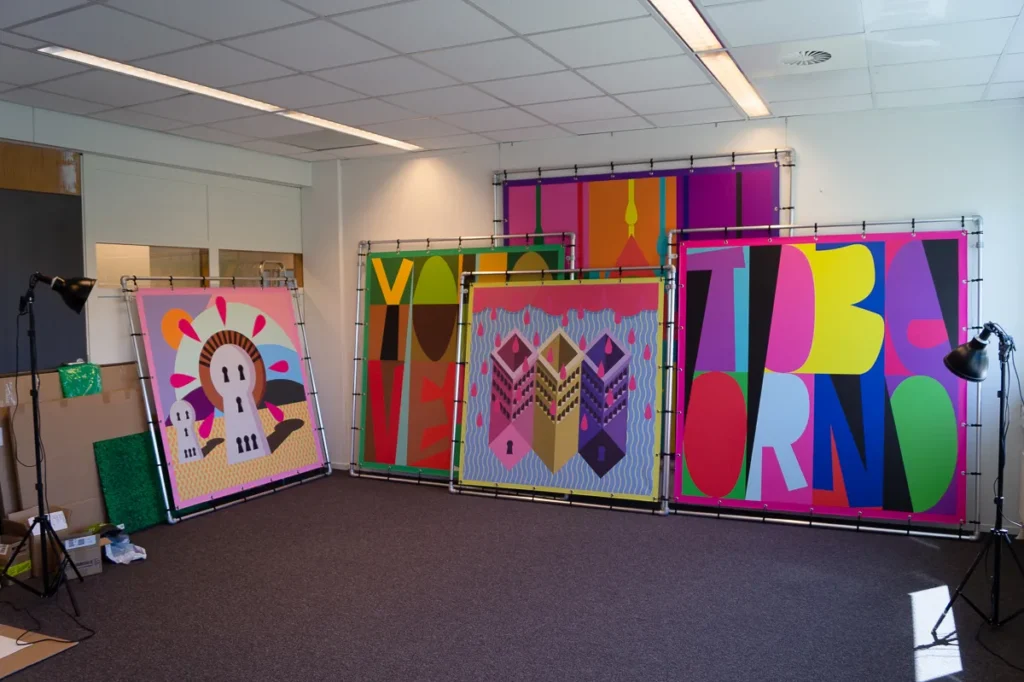
Three locked towers in shades of pink, ochre and purple are suspended against an rolling background. The sky above the buildings is filled with blood-red clouds from which pink tears descend. The atmosphere of this print from the ‘Icons’ series is ceremonial and suffocating, despite the colourful palette that is so typical in Ingmar’s work.
This work is an icon of sorrow, in which grief lies hidden behind thick walls. It is a depiction of a great flood, the story of blood-red tears being shed by a god upon his failed work.
Features and specifications
Title: Die Welt weint Year: 2019 Software: Illustrator Process: Fine art print Material: Watercolor paper Dimensions: 50×50 cm
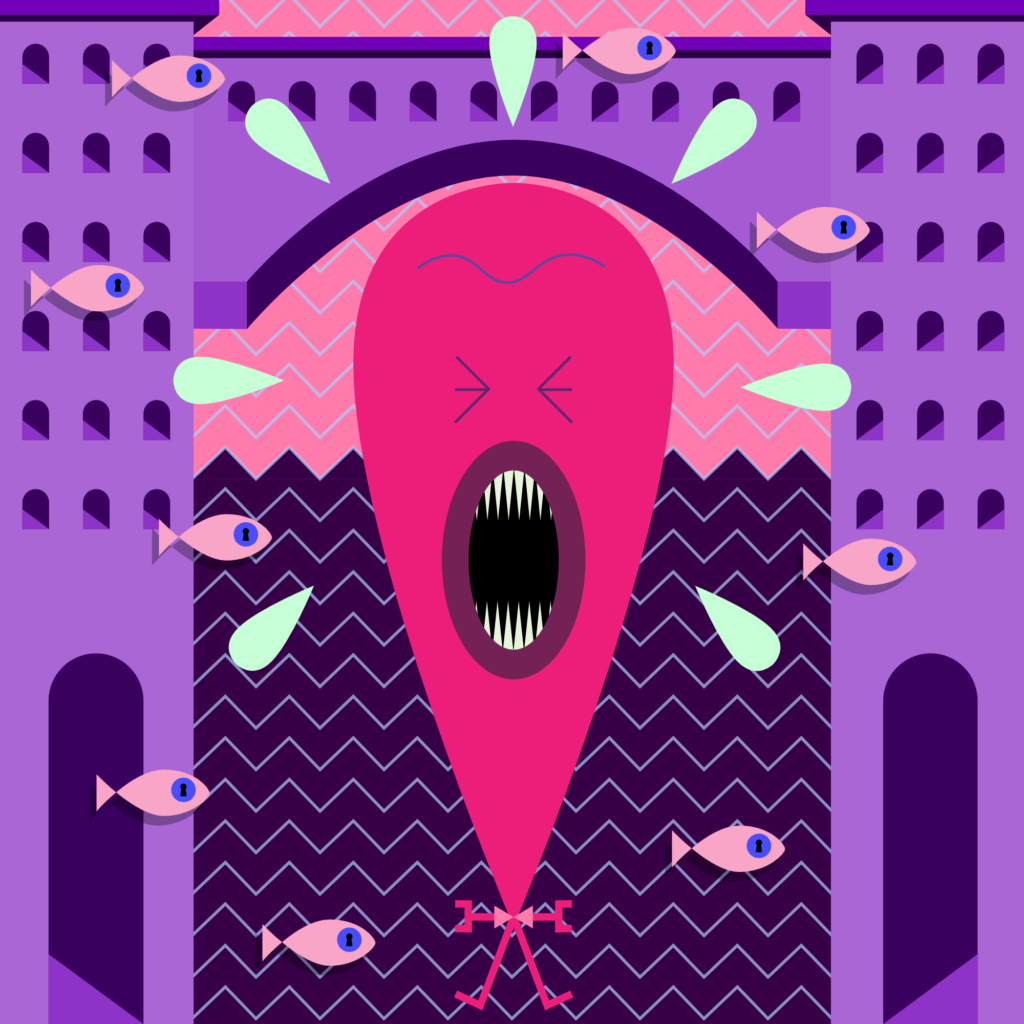
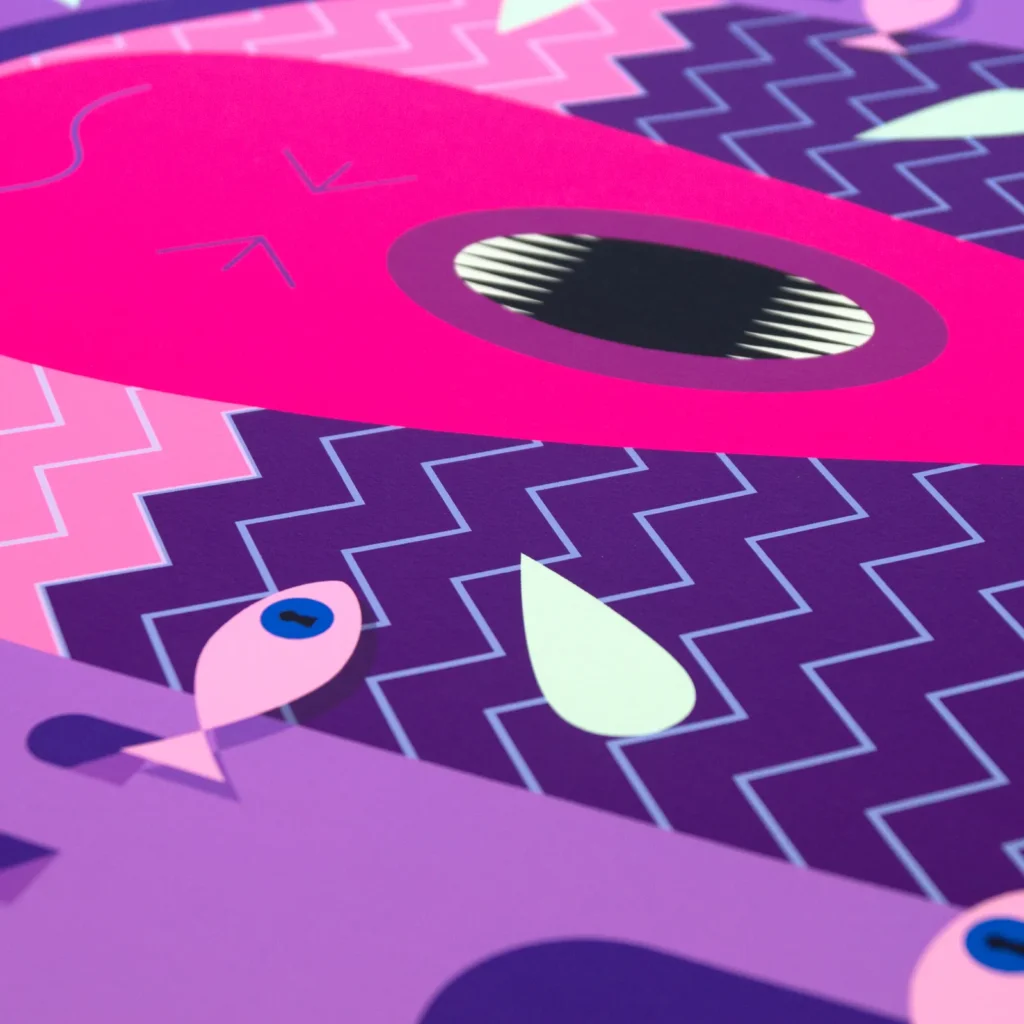
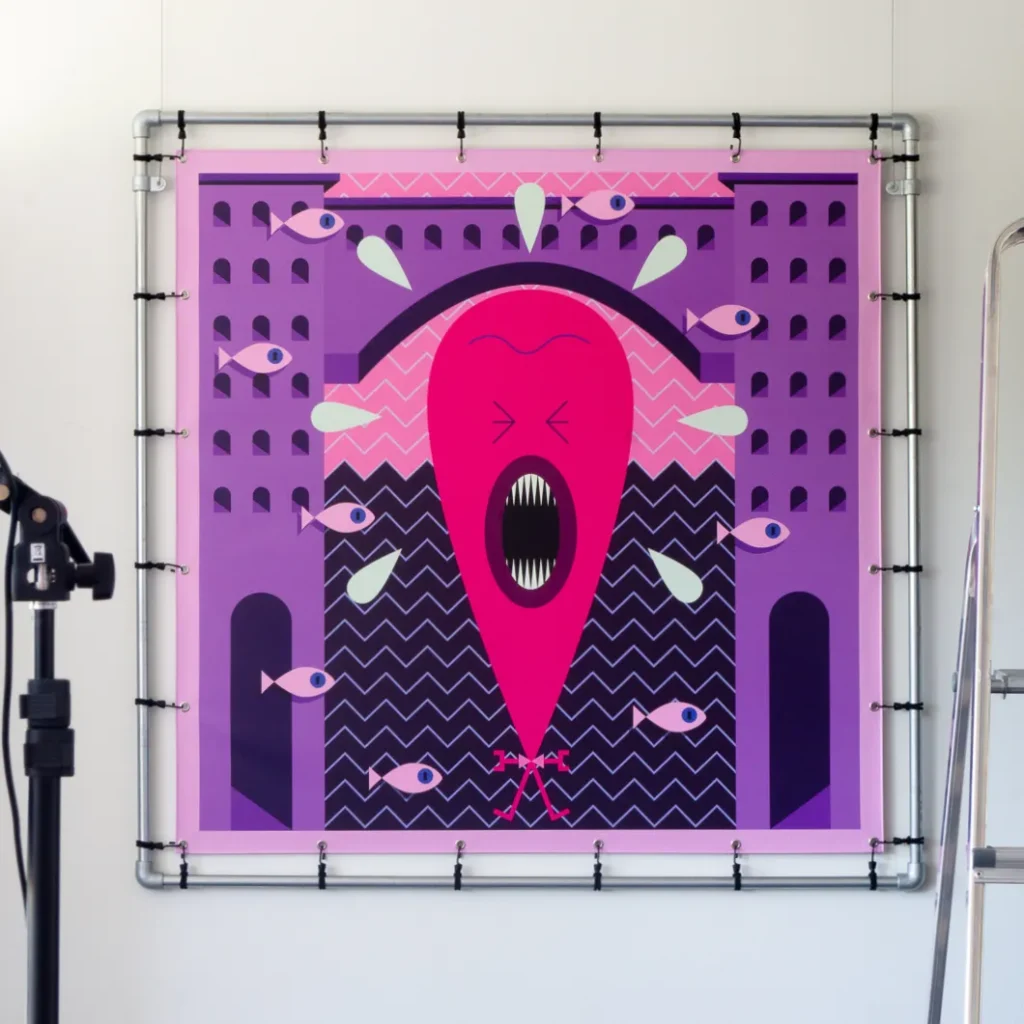
This loud print in neon colours is full of direct and indirect references. An elongated pink cartoon figure takes centre stage, with an enormous head, tight-closed eyes and a mouth full of sharp teeth. It hangs between two towers connected by an arched passageway that appears to refer to the Bridge of Sighs in Venice, and almost literally represents the gateway to Europe. In the background, the beach and sea are drawn as an angular bed of nails. Tiny fish with large blue eyes float through the image like passing bystanders.
This work is discomforting and harsh. The swollen head evokes associations with a body that has been submerged in water for too long. The scream, the neon colours and the rugged shapes make the image painful to look at. The sea is hostile, the building institutional, the fish unemotional. Their pupils are dark keyholes.
In the Icons verwijzen vissen meestal naar Christus, niet als religieuze figuur, maar als mens die verantwoording eist. Dit is waar de preciese aanklacht in dit werk zit: collectief weigeren we compassie toe te laten voor mensen die in gammele bootjes voor armoede, vervolging en oorlog op de vlucht slaan.
‘On Cruelty' is another of Ingmar’s works that reflects on collective cruelty.
A day at the beach – Fine art print on watercolour paper, 50×50 cm (2019)
This work has been published in various editions. These include a large inkjet print on vinyl measuring 150×150 cm and a fine art print on watercolour paper measuring 50×50 cm.
Features and specifications
Title: A Day at the Beach Year: 2019 Software: Illustrator Process: Fine art print Material: Watercolor paper Dimensions: 50×50 cm
On my way to the supermarket, I passed a group of teenagers, aged 14–15. Last in the group was a boy whose expression seemed to be suspended somewhere between surprise and disappointment.
Fine art print op aquarelpapier 30×30 cm (2019)
This work is part of a small series of portraits on angst and confusion.
Features and specifications
Title: Green Year: 2019 Software: Illustrator Process: Fine art print Material: Watercolor paper Dimensions: 30x30 cm
On my way to the gym in my home town, I pass an elderly man accompanied by a young woman. As I cycle by, I recognise something flickering across his face, caught between surprise and confusion.
Blue – Fine art print on watercolor paper, 30×30 cm (2019)
This work is part of a small series of portraits on angst and confusion.
Features and specifications
Title: Blue Year: 2019 Software: Illustrator Process: Fine art print Material: Watercolor paper Dimensions: 30x30 cm